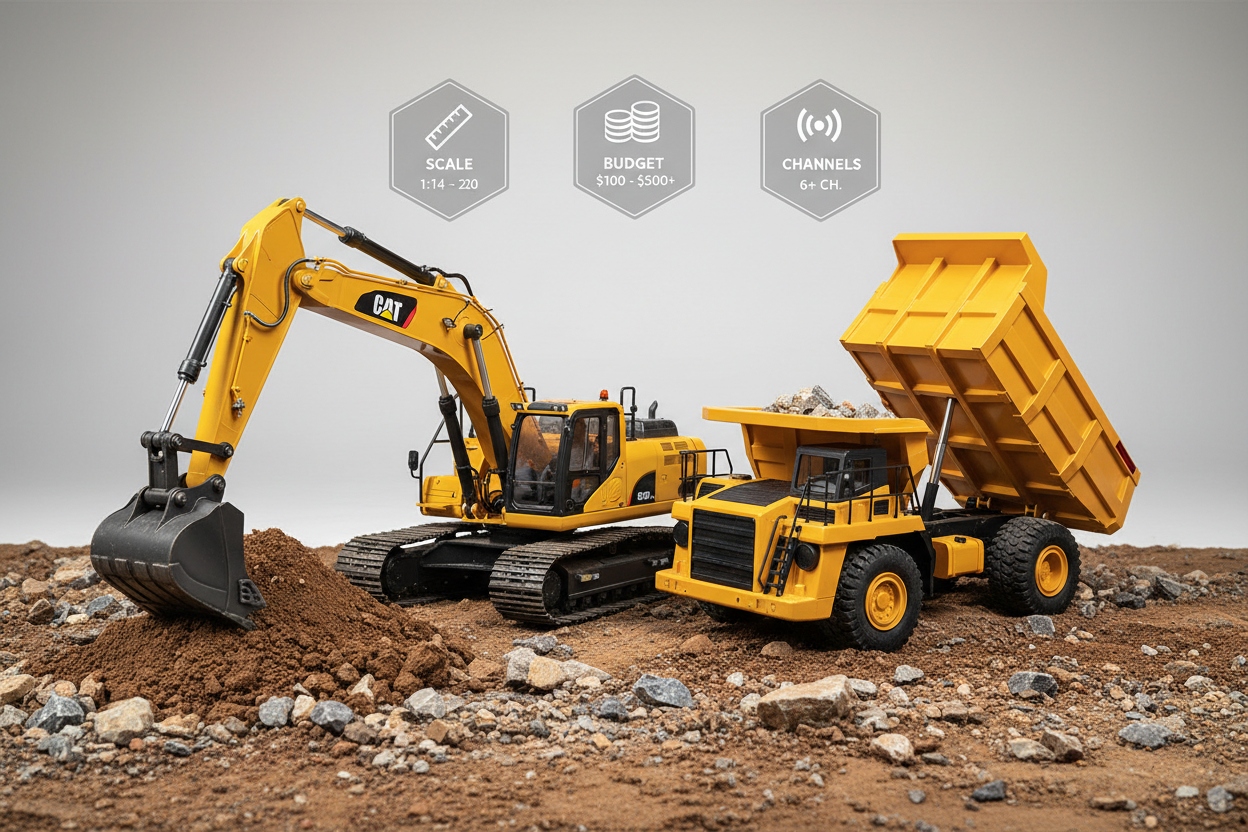

When shopping for your first or next RC excavator, every hobbyist faces one critical question: should you choose a plastic RC excavator or an alloy RC excavator? These two mainstream material types define the toy’s durability, play experience, modification potential, lifespan, and overall value for money. Many beginners mistakenly assume “alloy is always better” or “plastic is cheap and worthless.” In reality, both materials have unique strengths, suitable for different age groups, play scenarios, budgets, and hobby goals. This in-depth buying guide breaks down the core differences between alloy and plastic RC excavators, helping you figure out which one truly deserves your investment.
1. Core Material & Build Quality Difference
Most entry-level RC excavators on the market adopt high-quality ABS plastic as the main body material. This industrial-grade plastic is lightweight, flexible, and anti-collision by design. Manufacturers use integrated injection molding technology to shape the body, arm brackets, and bucket, making the whole machine portable and easy for kids to operate. Plastic models feature soft structural toughness; they rarely break sharply after falls or minor collisions, effectively protecting children from sharp broken fragments.
Alloy RC excavators, by contrast, use die-cast zinc alloy and aluminum alloy for core components including the digging arm, boom, bucket, gear base, and chassis frame, with only a small part of auxiliary structures retaining premium plastic. The alloy material delivers rigid, solid build quality with strong compression and impact resistance. Unlike plastic models that deform or loosen after long-term use, alloy structural parts maintain stable calibration, ensuring every digging and lifting movement stays precise for years.
2. Durability & Outdoor Play Performance
Durability is the biggest gap between plastic and alloy RC excavators, especially for outdoor high-intensity play. Plastic excavators work perfectly for indoor carpet play, sandbox light digging, and casual parent-child interaction. However, they have obvious limitations in complex outdoor scenarios: frequent digging of hard gravel, accidental drops on concrete ground, and long-term friction will gradually wear plastic gears, bend arm joints, or even crack the fuselage. For players who only play occasionally, plastic durability is fully sufficient, but it cannot support heavy-duty long-term use.
Alloy RC excavators excel in outdoor rugged environments. Reinforced alloy arms and metal gears effectively resist impact and load pressure, supporting continuous heavy digging, gravel shoveling, and repeated lifting operations. Even with accidental drops and collisions, alloy parts are not easy to deform or damage. For hobbyists who love backyard construction simulation, outdoor field play, and long-term frequent use, alloy models greatly reduce the frequency of parts replacement and maintenance, saving subsequent time and cost investment.
3. Simulation Realism & Visual Texture
For many RC construction vehicle collectors, simulation degree is a key purchasing factor. Pure plastic excavators have a uniform matte plastic texture, lacking the mechanical layering and metal texture of real engineering vehicles. Although modern plastic models are exquisite in detail, they still have obvious toy attributes and are not suitable for high-end display and collection.
Alloy RC excavators restore the metallic luster and heavy texture of real excavators. The metal casting process reproduces mechanical lines, structural gaps, and component layering of real construction machinery. Paired with simulated light and sound effects, alloy models present a highly realistic construction site working state. Whether for daily play, video shooting, or desktop display, alloy excavators have far higher ornamental and collection value than plastic versions.
4. Modification Potential & Expandability
Modification is the core fun of advanced RC toy hobbies, and material directly determines the upgrade space. Plastic RC excavators basically have no modification potential. Their integrated plastic structure and non-standard interfaces cannot support replacement of upgraded parts, and modified heavy accessories will easily cause structural deformation and damage. They are fixed-play toys with no expandable space.
Alloy RC excavators are designed for DIY modification. Brands like Huina and Kabolite adopt modular alloy structures and unified standard interfaces, compatible with a complete set of aftermarket accessories including hydraulic kits, log grapples, rock breakers, high-torque servos, and multi-mode light sets. Players can freely upgrade performance, replace functional attachments, and enhance realism according to personal preferences, turning a single-function excavator into a multi-purpose professional construction model.
5. Price & Long-Term Cost Performance
Plastic RC excavators occupy the low-to-medium price range of $40–$150, with ultra-low entry thresholds. They are cost-effective short-term entertainment products, requiring no extra investment, and are very suitable as holiday gifts for kids and entry-level trial play for beginners. The only drawback is the short service life and easy loss of precision after frequent use.
Alloy RC excavators are priced above $150, with professional full-alloy hydraulic models even exceeding $800. Although the upfront cost is higher, their service life is several times that of plastic models. They avoid frequent replacement caused by damage and support long-term iterative upgrades. From the perspective of long-term hobby investment and repeated use, alloy models have higher comprehensive cost performance.
Final Verdict: Which One Is Worth Your Money?
Choose Plastic RC Excavators if: You are buying toys for kids aged 8–14, only need casual indoor and light outdoor play, have a limited budget, or just want to try RC construction toys for fun. Plastic models are lightweight, safe, cheap, and fully meet daily entertainment needs.
Choose Alloy RC Excavators if: You are an adult hobbyist, pursue realistic mechanical texture and precise operation, need outdoor high-intensity digging play, like DIY modification and part upgrading, or want collectible-grade RC models for long-term display and use.
Conclusion
There is no absolute good or bad between alloy and plastic RC excavators—only suitability. Plastic models focus on cost performance and entry-level entertainment, while alloy models focus on durability, playability, and long-term hobby value. Clarify your play scenarios and budget, and you can easily pick the most worthwhile RC excavator to start your miniature construction hobby journey.